
Schlagwort: glTF

  • E128 – Entlassungen bei Snap, Microsoft und Meta, HR-Studie und Apple Smart Glasses Gerüchte mit Gerhard Schröder von ViSales

    avatar
    Thomas Riedel
    avatar
    Thomas Bedenk
    avatar
    Gerhard Schröder

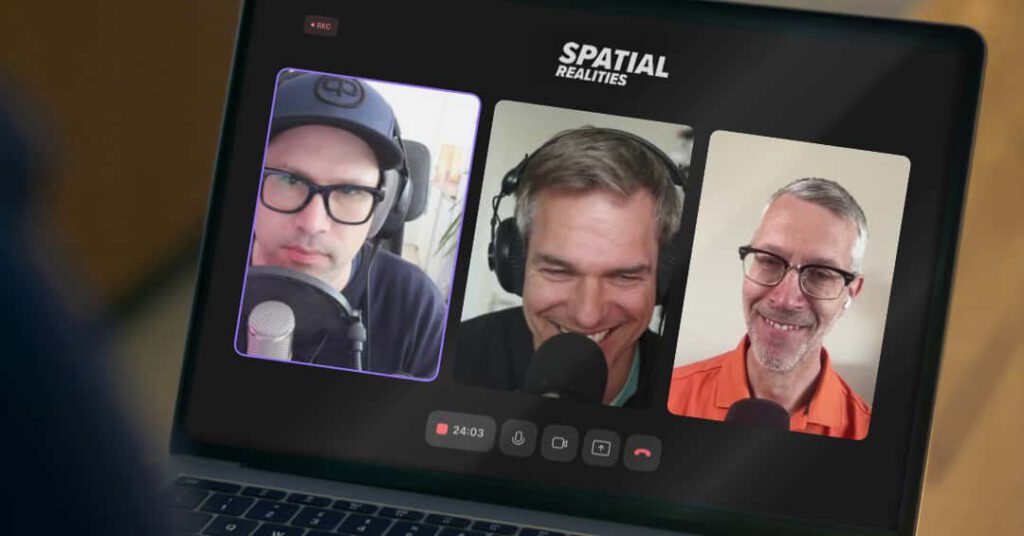
    In der 128. Episode von Spatial Realities ist Gerhard Schröder, CEO von Visales und Experte für das Apple-Ökosystem, erneut zu Gast, um die aktuellen Entwicklungen im Bereich Spatial Computing zu analysieren.

    Die News-Sektion beginnt mit dem massiven Stellenabbau bei Snap: Trotz des bevorstehenden Spectacles-Launchs entlässt das Unternehmen rund 16 Prozent seiner Belegschaft, was wir im Podcast vor dem Hintergrund der Fokussierung auf das Social-Media-Kerngeschäft einordnen. Währenddessen verdichten sich die Gerüchte um Samsungs Projekt „Haean“, eine für 2027 geplante AR-Brille mit Micro-LED-Technik.

    Ein weiterer Schwerpunkt ist eine neue PWC-Studie, die den Erfolg von VR-Onboarding im Personalwesen belegt, wenngleich die hohen Produktionskosten für 3D-Inhalte die flächendeckende Einführung erschweren.

    Im Zentrum der Diskussion steht zudem der potenzielle Führungswechsel bei Apple: Hardware-Chef John Ternus, der über Erfahrung im Design von VR-Headsets verfügt, ist der Nachfolger von Tim Cook. Wir diskutieren die Leaks über vier verschiedene Smartglass-Konzepte, bei denen Apple vermutlich einen iterativen Design-Ansatz verfolgen wird. Abschließend erläutert Gerhard Schröder die wachsende Bedeutung von OpenUSD. Durch den Beitritt von Google und Microsoft festigt sich dieser Standard, der komplexe 3D-Szenen effizienter verwalten soll als glTF und bereits jetzt die Grundlage für immersive Web-Erlebnisse unter visionOS bildet.
    Shownotes

  • E117 – UnitedXR: The State of the Metaverse Standards Forum, Standards for AI and what about Apple? with Neil Trevett

    avatar
    Thomas Riedel
    avatar
    Neil Trevett

    Summary

    Today, we are heading to Brussels. At the premiere of UnitedXR (YouTube →), I sat down with an absolute heavyweight of the industry: Neil Trevett.

    If you work in graphics, you know Neil. He is the VP of Developer Ecosystems at NVIDIA, President of the Khronos Group, and Chair of the Metaverse Standards Forum.

    In this conversation, we dive deep into three key topics: First, the current state of the Metaverse Standards Forum. Second, Apple’s role in XR—and specifically the tension between the USD and glTF file formats. And finally, how standard organizations are handling the explosion of AI assets and new tech like Gaussian Splatting.

    This interview is essential listening if you want to understand the strategic side of XR and how to navigate the competing narratives in our industry.

    1. Reorganization of the Metaverse Standards Forum Trevett explains that the Forum is being streamlined based on initial experiences. Originally, they started with 18 different working groups to identify where the most interest lay. However, due to gaps and overlaps, these groups are now being consolidated into five core areas:

    • 3D Assets: Formats like glTF and USD, as well as topics like avatars.

    • Spatial Computing: Sensing, IoT, and connectivity.

    • Artificial Intelligence (AI): A horizontal topic that touches all areas.

    • Regulation and Privacy: Without trust in data privacy, the platform will not be used.

    • Ecosystem: General topics such as education.

    2. Definitions of Terms and the „Onion Model“ To resolve the confusion around terms like „Metaverse,“ „XR,“ and „Spatial Computing,“ Trevett uses the analogy of an onion ring:

    • The Core is XR: An umbrella term for the hardware, meaning Augmented Reality (AR) and Virtual Reality (VR) with sensors and displays.

    • The Middle Layer is Spatial Computing: This is the term Apple prefers. It describes using displays and sensors to interact with the immediate environment.

    • The Outer Layer is the Metaverse: This emerges when multiple people using spatial computing are connected with each other.

    3. Vision: AR vs. VR Trevett clearly distinguishes his vision from dystopian ideas, such as those outlined in Matthew Ball’s book or „Ready Player One,“ where people spend 24 hours a day in VR. He believes that Augmented Reality (AR) will be the „true metaverse.“ His argument is that AR overlays the real world with contextual information and brings people together, rather than isolating them in a purely virtual world.

    4. The Role of Apple He praises Apple as a company capable of building the entire technology stack itself. Although Apple does not currently use open standards for spatial computing, Trevett does not view this negatively. He explains that proprietary platforms can often innovate faster than open standards and that both approaches complement one another.

    5. Importance of AI and New Standards AI is described as essential for building the metaverse because it solves problems that previously seemed unsolvable, such as semantic understanding of the environment or gestures.

    • Hardware Level: The Khronos Group is working on integrating Machine Learning (ML) acceleration directly into graphics APIs like Vulkan so that AI models can run efficiently on glasses.

    • Gaussian Splatting: A concrete example of new standards is the integration of „Gaussian Splats“ (a technique for rendering 3D scenes) into the glTF format. A draft for this already exists and is scheduled to be finalized in early 2026.

    6. The Wish for a „Metaverse Browser“ When asked about a „magic wand“ wish, Trevett responds that the metaverse is the spatial evolution of the web. He wishes for a kind of open-source „Metaverse Browser“ or a sandbox. This would be a collaborative environment where developers can test standards and identify gaps in the interoperability of various 3D web technologies.

    Shownotes

    Transparency: The Google AI Tool Gemini was used to transcript the interview, generate a summary and correct the intro. Adobes GenAI-Tool for podcasts was used to optimize the on-location recording. Also the chapter marks have been generated with Adobes transcription and Gemini file analysis capabilities. Both tools have been used with caution. For example: You can still hear background noise and even a sirene in the background, although the background noise has been dramatically reduced.