


This interview was originally sourced during my coverage of XR Expo.
Frédéric is always wearing two hats, he repeats whenever he can. One is as the head of the XR Division at Collabora. The other is the hat of an Outreach Officer for OpenXR. When you work with him as a journalist, you recognize that immediately. He is always aware of what he can and cannot say, driven by the politics within his organizations. That includes negotiations about which passages stay in the podcast and which do not. Only three small parts were removed from our original recording due to that process. None of them are important for normal people, but very important for people within the OpenXR cosmos, it seems.
Why do I mention this? Working on standards like OpenXR is a matter of politics—between big corps, open-source evangelists, and XR enthusiasts. That is what I learned after the podcast recording.
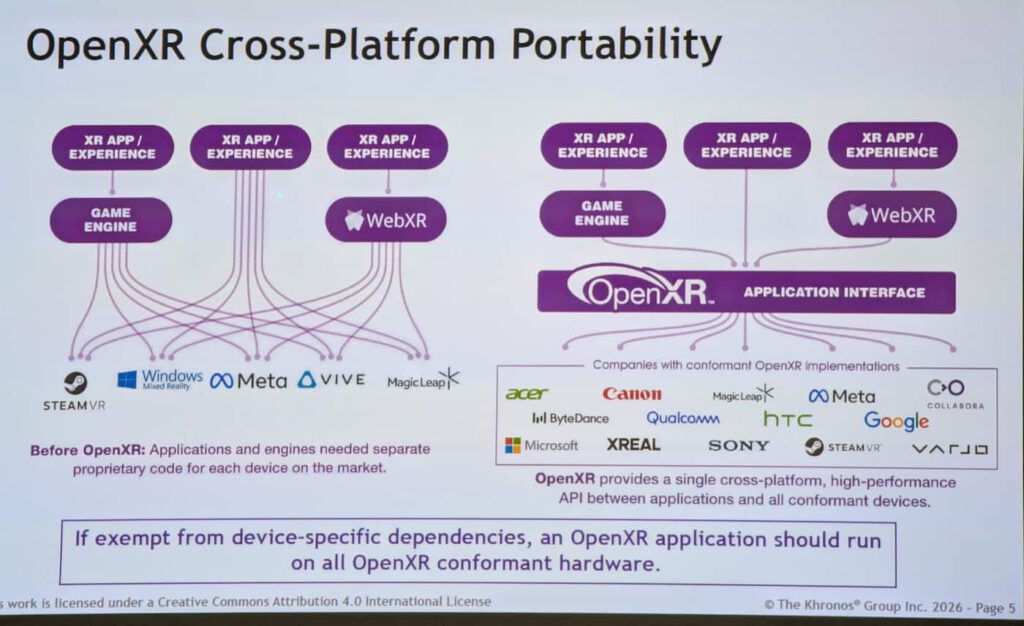
In this interview, Thomas Bedenk and I try to get a feeling of where OpenXR stands, how it has developed over the last couple of years, and where it is heading. OpenXR was built in 2017 with the vision to clean up a landscape of messy SDKs. In 2019, version 1.0 was released. But it has only been within the last 18 months that OpenXR has become the quasi-standard for XR development.
The reason behind this is not only the existence of standards, but that major stakeholders committed to OpenXR. Google, Meta, Valve, and Pico recognized the necessity of common ground for development. Unity and Unreal committed to OpenXR as their primary interface.
But standards alone are not enough if you really want to develop effectively. Monado delivers an open-source runtime which is used throughout the industry. As head of XR, Frédéric and his team are responsible for Monado. Monado is a cross-platform, open-source runtime that implements the OpenXR API to communicate directly with XR hardware like headsets, displays, and trackers. Unlike proprietary systems, its code is fully accessible to the public and is used by major tech companies as the foundational layer for their own XR ecosystems.
Although many of the organization’s current projects are restricted by NDAs, Frédéric shared insights into a major upcoming feature called multi-app support. This feature will provide a standardized way for multiple independent XR applications to coexist and interact realistically in the same physical space, enabling scenarios like a virtual Pokémon from one app correctly occluding a floating calendar from another.
Shownotes
- LinkedIn: Frédéric Plourde
- Monado – Open Source XR Platform
-
 OpenXR – Wikipedia
- OpenXR – High-performance access to AR and VR —collectively known as XR— platforms and devices
The sponsor of this issue: IMMERSIVE X
IMMERSIVE X 2026 will take place from November 10–12.
Would you like to participate or submit a session yourself? Registration is already open. https://immersive-x.de/
Schreibe einen Kommentar