Archiv: Episoden

  • E137 – Draymond Green’s 180° Doc, Meta VR Glasses FOV Drama, Samsung Smart Glasses & TDK’s Retinal Projection

    avatar
    Thomas Riedel
    avatar
    Thomas Bedenk

    WATCHING FILMS IN VR: DRAYMOND GREEN & IMMERSIVE STORYTELLING
    Thomas Riedel and Thomas Bedenk checked out Meta Quest’s new docuseries Open Season featuring NBA bad boy Draymond Green, and they’re definitely digging the 180-degree stereoscopic setup shot on Blackmagic Ursa cams. You genuinely feel like you’re riding shotgun in his Porsche, but whether this kind of expensive, subsidized storytelling will ever turn a real profit remains a big question mark.

    FOV DRAMA: THE NEW META VR GLASSES
    VR enthusiasts are already whining about the rumored 70-degree field of view and Meta’s 54-degree dev safe zone, but the hosts aren’t sweating it. Sure, following a fast-moving ball in sports might suck with a narrower view, but paired with crisp OLEDs, it’s more than enough screen real estate to chill on the couch and binge movies.

    HARDWARE LEAKS: SAMSUNG’S INCOMING SMART GLASSES Spotted
    FCC filings hint that Samsung is finally getting ready to drop its own displayless AI glasses, teaming up with Warby Parker and Gentle Monster for a bunch of frame styles. As an Android fanboy, Thomas is hyped to get proper ecosystem integration and give Meta some much-needed competition in the wearable game.

    LASERS TO THE EYE: TDK’S DIRECT RETINAL PROJECTION
    TDK showed off a new setup that bounces lasers straight onto your retina via meta-optic mirrors, neatly killing the annoying vergence-accommodation conflict. It could pave the way for super slim, normal-looking frames, but with monochrome green visuals and the nightmare of needing pinpoint eye tracking, it’s not taking over the world just yet.
  • Special – Meta Connect 2026 – All about Muse, Glasses and the Puck

    avatar
    Thomas Riedel
    avatar
    Thomas Bedenk

    Is Meta serious about confidential VMs for Muse?
    Is Charm targeted at kids?
    Are Meta VR Glasses the best VR glasses yet?

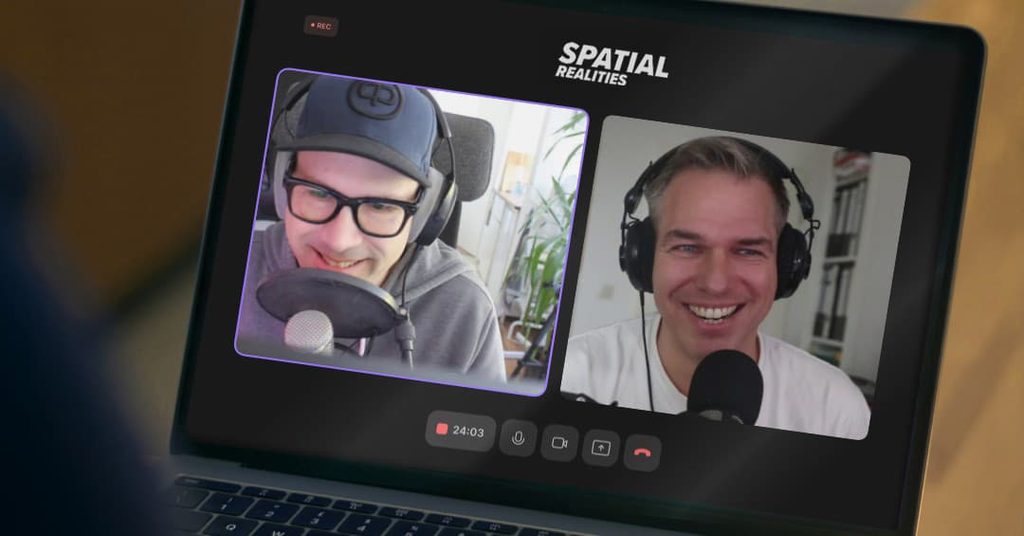
    In this episode Thomas and Thomas are discussing Meta Connect revelations of 2026!

    Five years after the metaverse hype, we find ourselves in an era defined by smart glasses and compute pucks. That is the central takeaway from this Meta Connect special of Spatial Realities, where Thomas Bedenk and I sat down right after the keynote to analyze Meta’s latest announcements and what they mean for the XR landscape.

    The clear centerpiece of Meta’s strategy is AI, spearheaded by Meta Muse—an autonomous agent running in private virtual machines designed to plan, purchase, and manage everyday digital life. Alongside Muse came an unexpected hardware companion: the Muse Charm. Shaped like a Tamagotchi with a display, camera, and 5G connectivity, it strips the assistant down into a standalone, approachable physical token. But while it feels accessible, it also raises immediate questions about target audiences, privacy boundaries, and how comfortable we truly are handing over our digital routines to an AI ecosystem.

    On the glasses front, Meta expanded its hardware lineup across multiple tiers. Most notable is the move into pure audio glasses without cameras, trading optical data capture for privacy-conscious users, lighter weight, and extended battery life. Meanwhile, the flagship Ray-Ban Meta line received a Gen 3 upgrade featuring slimmer frames, improved battery life, six microphones, and Dolby Atmos spatial audio capture, accompanied by new frame styles and software-driven hearing corrections.

    The most discussed hardware of the night, however, was the new Meta VR glasses. Positioned with the tri-part marketing pitch „cinema, computer, console,“ the device weighs roughly 100 grams on the face by offloading its processing and battery into a wired pocket puck. With micro-OLED displays running at 120 Hz, downward-facing cameras for hand tracking, and integrated eye tracking, Meta aims to deliver a high-clarity spatial viewer rather than an ultra-wide FOV headset. It serves as a spiritual successor to the Quest Pro line, sacrificing peripheral immersion for portability, high PPD sharpness, and lighter wear.

    At $1,299, the VR glasses mark a distinct shift toward portable media consumption and lightweight computing. Yet, as we examine in our discussion, Meta’s recurring bottleneck remains unchanged: while hardware form factors are shrinking into practical devices, the ecosystem still lacks dedicated, mature productivity software to turn spatial computing into an indispensable everyday tool.

    PARTNER OF THE EPISODE: IMMERSIVE X

    Shownotes

  • E136 – AI Glasses Hackathon & IFA Recap, Hardware News with HTC VIVE Eagle and RayNeo iO and NextApp Feature with Greg Fawsom

    avatar
    Thomas Riedel
    avatar
    Thomas Bedenk
    avatar
    Greg Fawson

    IFA BERLIN RECAP

    In this Episode Thomas Riedel and Thomas Bedenk share their takeaways from IFA Berlin, balancing stage debates on the societal impact and privacy of smart glasses with hands-on tests of new hardware from RayNeo, Rokid and Meta. Cutting through the show floor’s generic gadget noise, they highlight Android XR as a much-needed unifying layer to standardize development across fragmented wearable form factors.

    HARDWARE NEWS & INDUSTRY ANNOUNCEMENTS

    HTC is doubling down on smart glasses as traditional revenue streams decline, expanding the Vive Eagle into North America, Europe, and Australia. We examine its rounded Panto design, slow-motion capture, and snap-on magnetic battery, alongside the viability of its post-trial AI subscriptions. They also look ahead to Meta’s newly announced workflow tool Muse and its upcoming glasses integration, followed by expectations for Apple’s imminent product event. Because if the ApirPod Cameras are coming that is Spatial Computing!

    FEATURE: NEXTAPP DEVCON & BRIDGING MOBILE, GAMING, AND XR

    Where will the developer base for mass-market XR originate? NextApp CEO Greg Fawson traces the event’s journey from Berlin’s 2009 Android meetups to a cross-platform summit, arguing that mainstream mobile engineers hold the real key to scaling spatial software. Previewing the upcoming three-day conference, the discussion covers dedicated tracks for XR, mobile gaming, and agentic AI coding, emphasizing the need for open community exchange to solve shared platform bottlenecks.

    Get your tickets for NextAppCon here:

    • Get one of 10 free ticket with the code spatialfree
    • Get one of 100 tickets for 50% with the code spatial50

    GenAI transparency notification: For this episode the audio of Greg has been optimized using the speach improvement tool of Adobe Podcast. No edits have been made with GenAI and no additional content was generated. All edits are made by hand with Adobe Audition.

  • E135 – The Headset-Prizes-Game, Bitkom AI Glasses Poll and how to develop for Snap Specs with Ines Hilz & Andrew Douglas (SunfloVR)

    avatar
    Thomas Riedel
    avatar
    Thomas Bedenk
    avatar
    Ines Hilz
    avatar
    Andrew Douglas

    INTERVIEW

    What do you do when you meet somebody at a hackathon you work really well with? You found a new company! That is exactly what Ines Hilz and Andrew Douglas did after teaming up at a Meta Hackathon in London, going on to launch Sunflower VR and develop their new AI-driven AR try-on mirror, Aeva Display. In the interview, they delve into developing within Snap’s ecosystem, highlighting how Lens Studio’s AI-assisted toolset, agentic workflows, and environmental tracking features empower creators. Finally, they share crucial advice for hackathon participants developing for Snap Spectacles, emphasizing the necessity of testing frequently on-device to properly calibrate typography, color palettes, and transparency for additive holographic displays.

    Tipp: How to utilize the Snap Spectacles to simulate AI Glasses to controll your local Ai Agents from anywhere just using the glasses.

    NEWS

    Shownotes

    GenAI transparency notification: For this episode the audio of the three guests has been optimized using the speach improvement tool of Adobe Podcst. No edits have been made with GenAI and no additional content was generated. All edits are made by hand with Adobe Audition.

  • E134 – Developing for AI Glasses + AI Glasses News with Christoph Spinger from Telekom MMS

    avatar
    Thomas Riedel
    avatar
    Christoph Spinger

    Interview

    Christoph Spinger is an XR Expert Engineer at Telekom MMS. When he isn’t leading teams and building cutting-edge products for clients, he regularly takes home prizes at contests and hackathons. Most recently, he won the XRCC Hackathon, currently the most important XR hackathon in Germany. His winning entry, „Handslation“, translates any object you hold in your hand to help you learn a new language. In his case: Korean. He built the app for both the Pico 4 Ultra and the Rokid AI glasses.

    Another highlight from his portfolio is Ballee, an experimental project exploring real-time object detection by bringing physical balls into interactive mixed reality scenarios.

    As one of the most active XR developers in the scene today, Christoph will be joining the upcoming AI Hackathon at STARTPLATZ (Sept 4–6 in Cologne) as a mentor and jury member for the „Contextual AI Challenge“ track. So you can really profit from his experience and excellence!

    To get participants hyped and prepared, Christoph sits down with us to share his personal hackathon playbook and insider dev tips:

    • App Inspiration: One fascinating „True Crime“ app concept for location-based AI glasses that Kristoff hasn’t built yet—and wants you to steal for the hackathon!
    • The 48-Hour Hardware Playbook: What is the exact step-by-step strategy when building for AI & AR glasses under time pressure?
    • Time Allocation: Why half of your hackathon time shouldn’t be spent on coding at all—and what you should do instead to impress the jury.
    • Team Dynamics: How to find the right teammates on-site in under 10 seconds.
    • Dev Workflow & AI Tooling: Why you don’t need to be a full game developer or native engineer anymore to build smart glasses apps, and how AI code editors like Cursor change the game.
    • Hardware Realities: The hidden technical bottlenecks (like Bluetooth speeds) you must consider when connecting smart glasses to a phone.

    We also discussed these news:

    • Samsung unveils more Smart Glasses designs at Samsung Unwrapped, July 22nd
    • OpenAI interested in Smart Glasses, says OpenAI President Greg Brockman. But makes that sense?
    • Essilor Luxottica, which is partnering with Meta to manufacture the most successful Ai glasses of all times the Meta Ray-Ban, is talking sales numbers: exponential and almost double than comparable time last year.

    Shownotes

  • E133 – Meta’s Glasses Drama, Even Realities Hits Unicorn Status & UBTECH’s Creepy Companion

    avatar
    Thomas Riedel
    avatar
    Thomas Bedenk

    With the summer holidays just around the corner, we gather for one last comprehensive round of XR news before the seasonal slowdown.

    → Inspired by Josef Erl’s latest newsletter on heise.de — where he declares the end of all-rounder headsets and proposes four new VR categories — Thomas and I discuss what the upcoming autumn hardware wave will actually deliver.

    → We also untangle the latest rumors surrounding Meta’s smart glasses: from „supersensing“ devices without privacy LEDs switched off to Meta’s aggressive countermeasures against hardware tampering. Plus: Meta is testing paid AI subscriptions. Meanwhile, Illinois has banned smart glasses behind the wheel entirely—we analyze the reasoning behind this drastic move.

    → In financial news, Even Realities has officially reached unicorn status with a new $150 million investment round. We look at why their camera-free, monochrome display approach is winning over investors.

    → Furthermore, the first dedicated Metaverse browser Artemis has launched, Thomas is explaining what it can actually do and we share our initial impressions.

    → Finally, we look at UBTECH’s new U1 companion. Is this humanoid robot genuinely the future of home assistance, or is it just a highly uncanny, overly flexible smart speaker on legs?

    Whatever you do this summer: Keep a cool head and be prepared. For that we suggest our XR calendar with all XR events you need.

    Shownotes

  • E132 – Meta goes Store Brand: Introducing Meta Glasses

    avatar
    Thomas Riedel
    avatar
    Thomas Bedenk

    The strategy to go with an already well-established brand has been contested by its own creator: Meta introduced Meta Ray-Ban glasses three years ago and created a blueprint which was supposed to explain why suddenly a lot of normal, non-XR people were buying AI glasses.

    Now, Meta has announced Meta Glasses; their own „store brand,“ cheaper but supposedly as good as the branded version, which challenges that blueprint. Thomas Bedenk and I, as well as many of you out there, have been asking why Meta is doing that. Sure, cheaper might always be better for wider adoption. Removing a designer glasses brand can make a product cheaper. But will it also remove the appeal? Will people wear glasses with a Meta logo on them? Was Meta forced to go cheaper because the trajectory already showed signs of slowing down? And what role does EssilorLuxottica play in this?

    The long-time partner, which is 3% owned by Meta and has a 10-year deal signed up to 2034, is not only profiting hugely from that cooperation. It is also in a situation where it could put pressure on its partner. The Italian-French corporation EssilorLuxottica might even be concerned about its own brand integrity regarding what Meta is doing concerning privacy and AI. Maybe EssilorLuxottica halted further brand cooperation without retracting access to its production facilities, we speculate.

    In this episode, we are analyzing Meta’s newest attempt in the smart glasses industry it created, and we share a clear position on whether you should buy these now-cheapest, but still great-looking, smart glasses.

    Shownotes

  • E131 – Qualcomms nächster XR SoC, Xreal Aura und Clarence Dadson über Gaussian Splatting und Scanning

    avatar
    Thomas Riedel
    avatar
    Thomas Bedenk
    avatar
    Clarence Dadson

    INTERVIEW

    Zum Interview haben wir Clarence Dadson geladen. Der Geschäftsführer von Design4Real und Vorstandsvorsitzender des Extended Reality Bavaria e.V. beschäftigt sich seit Aufkommen des Hypes mit Gaussian Splatting. Gaussian Splatting sorgt gerade durch seine Technik für Aufbruchstimmung in der Scanning-Landschaft. Durch winkelabhängige Ellipsoide wird ein beispielloser Fotorealismus inklusive komplexer Reflexionen und transparentem Glas möglich, der zuvor sehr viel mehr Zeit in Anspruch genommen hätte oder gar nicht möglich gewesen wäre. Die Erfassung per Kamera oder Scanner ist damit äußerst zugänglich geworden. Ein Vorteil gegenüber der traditionellen Fotogrammetrie. Diese Technik eignet sich ideal für detailreiche, statische Objekte wie Fahrräder, Immobilienpräsentation oder fotorealistische VR-Trainingskulissen.

    Ganz frei von technischen Hürden ist Gaussian Splating allerdings noch nicht: Die riesigen Datenmengen erfordern enorm leistungsstarke Hardware mit viel Grafikspeicher, und die Software-Integration in gängige Engines wie Unity oder Unreal ist noch sehr rudimentär. Zudem fehlt die nachträgliche Editierbarkeit, wie das mit einzelenn Objekten möglich wäre, da die Scans als untrennbarer Block ohne separate Materialien exportiert werden. Am Ende bleibt es eine kreative Tätigkeit: Wie führe ich den Scanner so, dass ich die Ergebnisse bekomme, die ich haben will?

    Das Zukunftspotenzial ist riesig, denn Unternehmen wie Gracia AI streamen bereits erfolgreich animierte 4D-Splats, indem sie durch clevere Delta-Kompression die Datenraten drastisch reduzieren.

    In Kooperation mit Spatial Realities, XGrids und dem Startplatz, hält Clarence am 13. Juli einen kostenlosen Ganztagesworkshop in Köln. Noch sind Anmeldungen möglich!

    Workshop: Gaussian Splatting & 3D Scanning im Praxistest →

    NEWS

    • Qualcomm Snapdragon Reality Elite
    • Xreal Aura

    Shownotes

  • Special – The New Snap Specs: Premium consumer design AR in 132 Grams of Plastic Titanium

    avatar
    Thomas Riedel
    avatar
    Thomas Bedenk

    And here they are! In this special episode of Spatial Realities we dive into the highly anticipated reveal of the new Snap Specs at the AWE 2026 conference. We take a close look at the hardware of this new AR device, exploring how its weight, display technology, and pricing compare to previous generations and competitors on the market. We also discuss the newly introduced AI-driven Lens Studio tools and what they mean for the developer ecosystem. Join us as we evaluate the real-world implications of its battery life, discuss the availability of compelling consumer use cases, and analyze Snap’s privacy concepts. Tune in to hear our views on whether these glasses are poised to become finally a mainstream success we all have been waiting for.

    Shownotes

  • E130 – What’s up, OpenXR? with Frédéric Plourde

    avatar
    Thomas Riedel
    avatar
    Thomas Bedenk
    avatar
    Frédéric Plourde

    This interview was originally sourced during my coverage of XR Expo.

    Frédéric is always wearing two hats, he repeats whenever he can. One is as the head of the XR Division at Collabora. The other is the hat of an Outreach Officer for OpenXR. When you work with him as a journalist, you recognize that immediately. He is always aware of what he can and cannot say, driven by the politics within his organizations. That includes negotiations about which passages stay in the podcast and which do not. Only three small parts were removed from our original recording due to that process. None of them are important for normal people, but very important for people within the OpenXR cosmos, it seems.

    Why do I mention this? Working on standards like OpenXR is a matter of politics—between big corps, open-source evangelists, and XR enthusiasts. That is what I learned after the podcast recording.

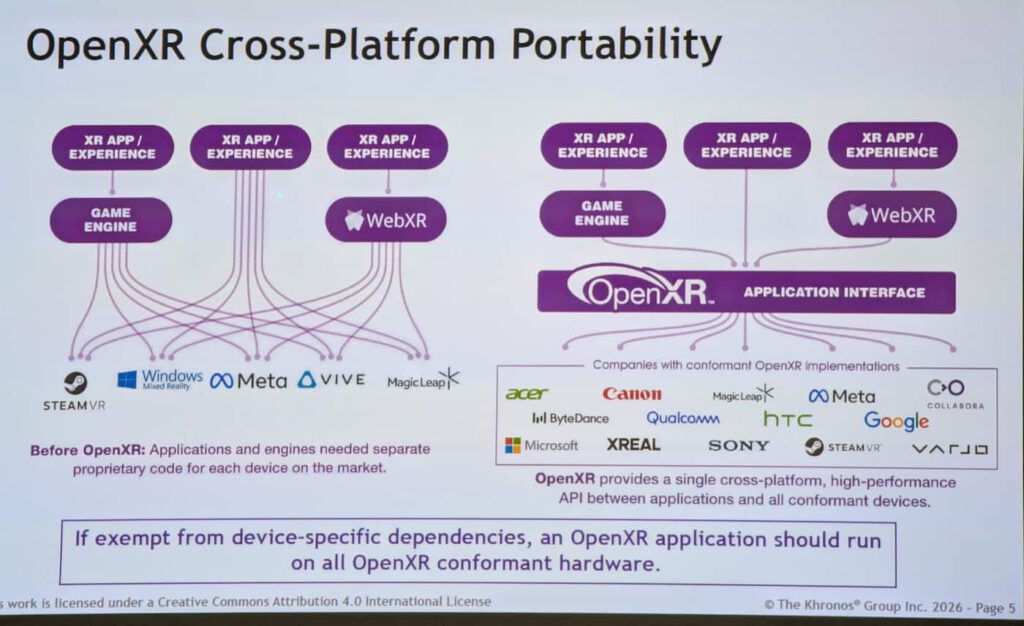
    In this interview, Thomas Bedenk and I try to get a feeling of where OpenXR stands, how it has developed over the last couple of years, and where it is heading. OpenXR was built in 2017 with the vision to clean up a landscape of messy SDKs. In 2019, version 1.0 was released. But it has only been within the last 18 months that OpenXR has become the quasi-standard for XR development.

    The reason behind this is not only the existence of standards, but that major stakeholders committed to OpenXR. Google, Meta, Valve, and Pico recognized the necessity of common ground for development. Unity and Unreal committed to OpenXR as their primary interface.

    But standards alone are not enough if you really want to develop effectively. Monado delivers an open-source runtime which is used throughout the industry. As head of XR, Frédéric and his team are responsible for Monado. Monado is a cross-platform, open-source runtime that implements the OpenXR API to communicate directly with XR hardware like headsets, displays, and trackers. Unlike proprietary systems, its code is fully accessible to the public and is used by major tech companies as the foundational layer for their own XR ecosystems.

    Although many of the organization’s current projects are restricted by NDAs, Frédéric shared insights into a major upcoming feature called multi-app support. This feature will provide a standardized way for multiple independent XR applications to coexist and interact realistically in the same physical space, enabling scenarios like a virtual Pokémon from one app correctly occluding a floating calendar from another.

    Shownotes


    The sponsor of this issue: IMMERSIVE X

    IMMERSIVE X 2026 will take place from November 10–12.

    Would you like to participate or submit a session yourself? Registration is already open. https://immersive-x.de/